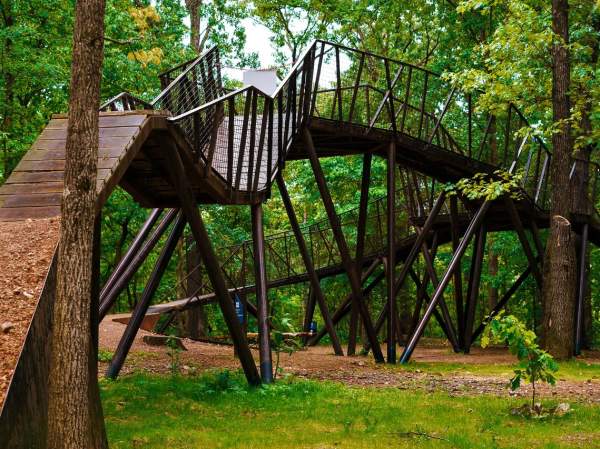
Bentonville, Arkansas, has built an expansive public art collection over the past decade, with over 300 works citywide, spanning murals, neon signs, and large-scale sculptures. The Peel Compton Foundation is part of that public art scene, with free outdoor art across their community spaces, the majority located at Coler Mountain Bike Preserve, Osage Park, and Compton Gardens & Arboretum. All are free and open to the public!
Why Art in Nature Just Hits Different
Most public art lives within the infrastructure of cities: on building walls, crosswalks, utility boxes, and plazas. The Peel Compton Foundation's collection is different. It's placed into nature, alongside wetlands, creek beds, bike trails, and gardens. That distinction turns out to matter in ways researchers are only beginning to study.
Both art and nature independently improve mood, reduce stress, and support mental well-being. That evidence is well-established. What's newer is what happens when they're combined. Researchers studying programs that pair arts- and nature-based activities together have found what they describe as "distinct synergistic benefits," outcomes that go beyond what either art or nature produces on its own. A 2022 systematic review from University College London noted that while the health benefits of nature and the benefits of arts are both well-documented, the interconnection between the two has received "scant attention" in the literature, which means places like Coler Mountain Bike Preserve, Osage Park, and Compton Gardens are, in a sense, ahead of the research.
The most compelling explanation for why the combination works comes from Professor Miles Richardson, who studies nature and wellbeing at the University of Derby. His research found that it was the increased noticing of nature, not the number of visits, that explained improvements in wellbeing. And that's exactly where art helps: "It acts as a provocation or a prompt. It makes you pause. You notice, and appreciate."
That's what the art at these three community spaces does. It gives you a reason to stop on a trail you might otherwise move through. The questions at each stop below are meant to help with that!
Quick List: Jump to the park or outdoor space you're visiting!
Coler Mountain Bike Preserve | Osage Park | Compton Gardens & Arboretum
Coler Mountain Bike Preserve
The public art at Coler runs along the Applegate Trail, the paved path open to both bikers and pedestrians. Start at the South Parking Lot and follow the trail in sequence, ending near Airship Coffee.
Coler Mountain Bike Preserve is built on land designated as a mountain bike preserve about a mile west of downtown Bentonville. Although you might think you are…
Parking: South Gateway, NW 3rd St., Bentonville, AR 72712
Stop 1: Singing Bridge
Near the South entrance, the bridge you cross is a sound installation by Craig Colorusso: prerecorded music played through solar-powered speakers. The music blends easily with wind and water, and you might not realize it's art at all until you're already inside it.
Ask yourself: When did you first notice the sound? Did it change how the natural sounds around it felt? Is there a song or a sound that, when you hear it unexpectedly, takes you somewhere else entirely? What does this one do?
Stop 2: shape. & Oversized Chair
Past the Firefly Sanctuary at the creek outlet, Griffin Loop's shape. spreads across a clearing in the woods as three distinct geometric elements, which makes it feel stranger and more alive against the completely unpredictable forest surrounding it. The Oversized Chair nearby offers a more playful counterpoint. Grab a photo.
Ask yourself: The repeating frames seem to pull you deeper into the forest. Does the piece feel like it's framing nature, or inviting you into it?
Stop 3: Someone and Someone
Continue down the trail to reach Eva Rothschild's Someone and Someone, large interlocking geometric forms in painted aluminum. Rothschild's work explores how negative space reads against solid material, and at roughly 13 feet wide, the piece holds its own against the tree line.
Ask yourself: Does the surrounding forest feel like it's completing the piece, or competing with it?
Stop 5: Paradise Found
At the Homestead area near Airship Coffee, Todd Sanders's Paradise Found neon sign glows from one of two restored original barns on the property. The contrast between the weathered barn and Sanders's lit sign is the whole idea. Sanders has created neon works at all three Peel Compton sites as well as many other locations around Bentonville.
Ask yourself: Neon usually belongs to diners, motels, and city streets. What does it feel like here, in the middle of the woods? Is there a place from your past where something out of place, a sound, a color, a sign, made it feel more alive? What was it?
Stop 6: Dinosaur
Peek behind Airship Coffee to find the last piece on the Applegate Trail, Dinosaur! Easy to miss if you don't know where to look! This is the perfect stopping point to take a rest, grab a cup of coffee, and start making your way back.
Osage Park
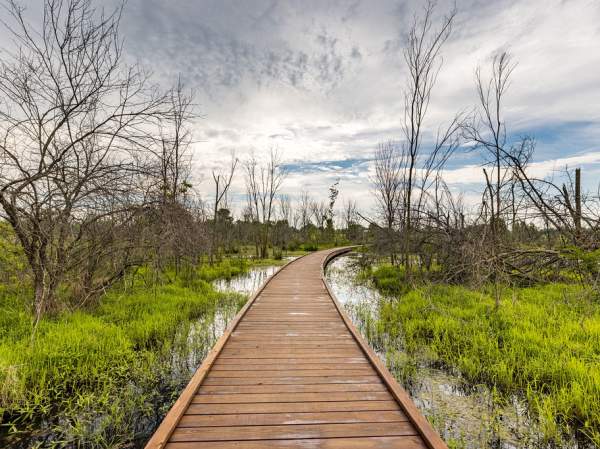
Osage Park packs six works of large-scale free public art into a wetland green space in Bentonville. The route loops around the lake, the prairie, and wetland areas, so you'll end up back where you started if you are game for a long walk. If you can only make it to one Peel Compton site at dusk, make it this one, so you can be sure to see all kinds of wildlife, including the resident beavers!
Recreation with all in mind. The ultimate urban park full of natural experiences and recreational adventures. Access our floating boardwalks around the park’s…
Parking: Osage Park lot, off of SW D St.
Stop 1: Shaved Portions
Right next to the parking lot stands Chakaia Booker's Shaved Portions, a massive sculpture of deconstructed steel-belted and bias tires. Booker transforms industrial rubber into dense, layered forms, and the material carries its whole history with it.
Ask yourself: Think of something worn out or used up that you've held onto anyway. What gives an object a life beyond its original purpose?
Stop 2: Fluttering Quilts & Osage Park Neon Sign
Follow the path toward the prairie to find Greely Myatt's Fluttering Quilts, which cuts traffic signs into traditional quilt patterns (Lady of the Lake, Tumbling Blocks, Drunkard's Path) and rivets them to painted aluminum plates. Myatt grew up in the Mississippi Delta watching quilts on his grandparents' clotheslines. At the fork in the road, you'll find Todd Sanders's Osage Park Neon Sign.
Ask yourself: Is there an object from your childhood that carried a whole world inside it? What would it look like translated into something else? Could you create your own Fluttering Quilts with this object? What would it be called?
Stop 3: Launch Intention
At 25 feet long, Griffin Loop's Launch Intention is based on the paper airplane, one of the first things we make as children. Loop describes the piece as "a reminder for all to free yourself. Set intention and launch into action and the world." It's one of three in a series by Loop throughout Bentonville, and one of the works you're encouraged to touch.
Ask yourself: What's the last thing you made with your hands just for the joy of it, with no particular purpose? How did it feel to let it go?
Stop 4: Garden Boats for Osage Park
Past The Quiver Archery Range, Jennifer Torres's steel boats slowly rotate in the wind, their fins catching the breeze. Torres drew the shapes from Osage Park's own winding paths, and for her, the boat holds multiple meanings: escape, return, utility, and recreation.
Ask yourself: These boats slowly turn in the wind, never quite settling in one direction. Is there a decision in your life you keep turning over the same way? The boats are shaped from the paths of this park, built for a place they can almost touch but never quite reach. Is there somewhere you keep coming back to in your mind?
Stop 5: Tall Grass
Asia Ward made Tall Grass specifically for this wetland, growing the piece from a specific imaginative act: "I wanted to make something that made me feel like I was a wetland creature looking up through the water at the tall grass." Stay on the elevated platform and let Ward's piece reorient your perspective.
Ask yourself: Ward made this to shift your point of view, to make you feel small. Does it work? When you look up through the piece, do you feel more inside the wetland or more outside of it?
Compton Gardens & Arboretum
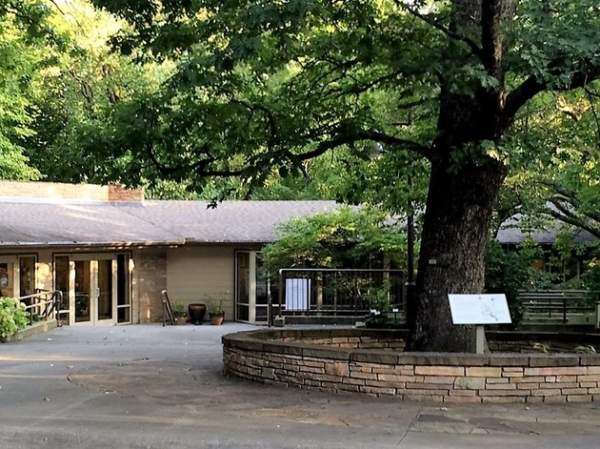
Compton Gardens & Arboretum is the most contained of the three Peel Compton Foundation sites, a mature garden and arboretum just north of downtown Bentonville. Start on 3rd Street outside the parking lot.
Compton Gardens & Arboretum is a peaceful seven-acre haven just one block north of Bentonville's historic city square, showcasing the natural beauty and…
Stop 1: Compton Gardens Neon Sign
You'll see Todd Sanders's neon sign before you enter the garden: Dr. Compton in a canoe, set against a large orange sun. Classic Sanders-style Americana, completing his neon trilogy across all these three Peel Compton sites.
Stop 2: Untitled (Wind Chimes)
On the Razorback Greenway into the garden, you'll find Sam Falls's Untitled (Wind Chimes). Despite its name, Falls's piece makes no sound.
Ask yourself: You expect sound. The name tells you to. What does the silence feel like? Does the garden's ambient sound fill the space you expected the piece to occupy? Is there something in your life that promised one thing and quietly delivered another? Was it better or worse than what you expected?
Stop 3: Heartland
Make a right into the meadow to find Daniel Popper's Heartland, a large-scale sculpture of human hands holding an open heart. Popper is a South African artist who moved from painting into large-scale installation, with commissions including a Nelson Mandela memorial statue in the Eastern Cape and major festival installations across Europe, the US, and Mexico. Heartland is among Popper's first permanent public sculptures and one of the most visited outdoor artworks in Bentonville.
Ask yourself: Popper chose hands over arms, a torso, a full figure. Why do you think just the hands were enough? The heart is open, not enclosed or protected. Does that feel like an act of courage or an invitation?
Stop 4: Group of Bears & Red Clay
When you come out of the meadow, walk toward the house to find Paul Manship's Group of Bears. In 1929, Manship began work on a bronze gateway for the Bronx Zoo that was never built, and sculpted these bears as part of that design. He later combined three individual bears on a single base. Nearby, Ed Pennebaker's Red Clay is a structure of textured, colored glass panels in a steel frame, worth visiting at different times of day as the light through Pennebaker's glass shifts considerably with the sun's angle.
Ask yourself: Manship made these bears for a zoo, a place where animals are framed for human viewing. Here they're in a garden, without an enclosure in sight. Does that change what the sculpture is about?
Before You Go
You don't have to think about any of this to enjoy these three sites. You can bike or walk past all of these without looking up, and still leave these spaces feeling better than when you arrived. That's what nature does on its own.
But the research suggests you'll get more out of it if you pause. Not for long, and not with any particular expertise. Just long enough to notice something: the way the mirrored cube makes the forest look a little foreign, the way Booker's tires feel stranger the longer you stand next to them, the way Ward's wetland piece makes the sky seem further away than it did a moment ago.
That noticing is the whole point. It's what the art is there to prompt, and it's what these green spaces are there to support. The fact that you can do all of it for free, on a Tuesday afternoon, with a cup of coffee from Airship at the end, is its own kind of remarkable thing.